You glance at the clock and wonder, how long until 2:15? Maybe a meeting starts then, a class ends, or a train leaves. The math is simple once you know the trick, and this guide walks you through it with clear examples, tables, and the mistakes to avoid.
By the end, you will be able to work out the time left in your head, in minutes or even seconds.
Answer in brief: To find how long until 2:15, subtract the current time from 2:15. If it is 1:00 PM, you have 1 hour and 15 minutes left. If it is 2:00 PM, you have 15 minutes. If 2:15 has already passed today, count forward to 2:15 tomorrow instead.
Quick Reference Table
| Current Time | Time Left Until 2:15 PM |
|---|---|
| 12:00 PM | 2 hours 15 minutes |
| 1:00 PM | 1 hour 15 minutes |
| 1:15 PM | 1 hour |
| 1:45 PM | 30 minutes |
| 2:00 PM | 15 minutes |
| 2:10 PM | 5 minutes |
Meaning / Definition
“How long until 2:15” asks for the gap between the present moment and the next 2:15 on the clock. The answer is a duration, such as 45 minutes or 3 hours and 15 minutes.
It is a basic time-difference calculation. You take a start time (now), an end time (2:15), and find what sits between them.
The question is incomplete without one detail: AM or PM. There are two 2:15s every day, and they are twelve hours apart.
Meaning in Simple Words

Think of it as a countdown. You are asking, “How much waiting is left before the clock reads 2:15?”
If you are early, the answer is a positive amount of time. If 2:15 already went by today, the next one is tomorrow, so the wait is longer.
Quick Answer
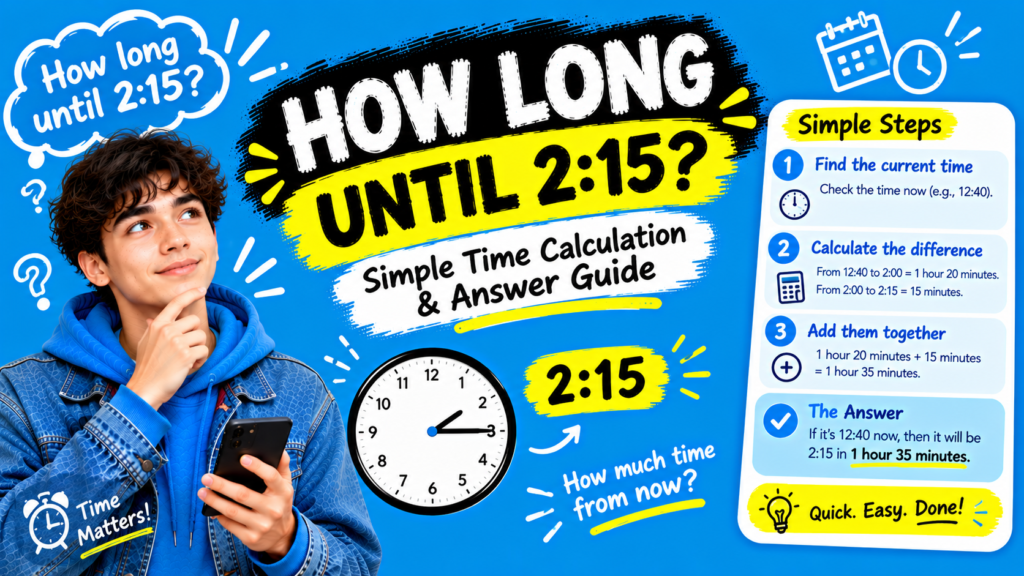
Use these three steps:
- Turn both times into minutes (or use the 24-hour clock).
- Subtract the current time from 2:15.
- Convert the result back into hours and minutes.
The 24-hour clock makes this easier. 2:15 PM is 14:15, so at 13:00 you simply do 14:15 minus 13:00, which is 1 hour 15 minutes.
| Step | What You Do | Example (Now = 1:00 PM) |
|---|---|---|
| 1 | Write both times in 24-hour format | 13:00 and 14:15 |
| 2 | Subtract | 14:15 − 13:00 |
| 3 | Read the result | 1 hour 15 minutes |
Real-Life Examples
All examples below assume the target is 2:15 PM, unless stated otherwise.
Example 1: It Is 1:00 PM
From 1:00 to 2:00 is 60 minutes. Add 15 more and you get 1 hour 15 minutes. This is a common lunch-break scenario: you have just over an hour before your next call.
Example 2: It Is 1:15 PM
The hour hand moves from 1 to 2, so exactly 1 hour remains. Whenever the minutes match (both :15), you only count whole hours.
Example 3: It Is 1:45 PM
From 1:45 to 2:00 is 15 minutes. From 2:00 to 2:15 is another 15. The total is 30 minutes.
Example 4: It Is 2:00 PM
The hour is already right. Only the quarter-hour is left, so you wait 15 minutes.
Example 5: It Is 2:10 PM
You are almost there. 2:15 minus 2:10 is 5 minutes.
Example 6: It Is 12:00 PM
Noon to 2:00 PM is 2 hours. Add the extra 15 minutes for a total of 2 hours 15 minutes.
Example 7: It Is 11:00 PM
This one crosses midnight, so the target matters.
- To 2:15 AM, the wait is 3 hours 15 minutes.
- To 2:15 PM the next day, the wait is 15 hours 15 minutes.
Always confirm which one you mean.
Example 8: It Is 3:00 PM
Today’s 2:15 PM is already gone. The next one is tomorrow, so the wait is 23 hours 15 minutes.
| Example | Current Time | Time Until 2:15 | Total Minutes |
|---|---|---|---|
| 1 | 1:00 PM | 1 hr 15 min | 75 |
| 2 | 1:15 PM | 1 hr | 60 |
| 3 | 1:45 PM | 30 min | 30 |
| 4 | 2:00 PM | 15 min | 15 |
| 5 | 2:10 PM | 5 min | 5 |
| 6 | 12:00 PM | 2 hr 15 min | 135 |
| 7 | 11:00 PM | 15 hr 15 min (to 2:15 PM) | 915 |
| 8 | 3:00 PM | 23 hr 15 min (tomorrow) | 1,395 |
Synonyms and Related Terms

People phrase this question in many ways. They all point to the same calculation.
Time Until 2:15
The most direct version. It asks for the duration between now and 2:15.
Time Remaining Until 2:15
Same idea, with a focus on what is left. Often used in schedules, exams, and timers.
Countdown to 2:15
A running timer that ticks down to zero at 2:15. Phones and kitchen timers do this well.
How Many Hours Until 2:15?
Useful when the gap is large. Divide the total minutes by 60. For example, 135 minutes is 2.25 hours.
How Many Minutes Until 2:15?
Best for short waits. Most people use this when the target is under two hours away.
2:15 Countdown
A shorthand search for a live countdown clock or timer set for that exact time.
Related Time Terms
| Term | Plain Meaning |
|---|---|
| Time difference | The gap between two clock times |
| Elapsed time | How much time has already passed |
| Time remaining | How much time is left |
| Quarter past | 15 minutes after the hour |
| 24-hour clock | A system where 2:15 PM is written as 14:15 |
| Time zone offset | The hour difference between two regions |
How many minutes until 2:15 PM today
Minutes are the easiest unit for short waits. Convert hours to minutes by multiplying by 60, then add the leftover minutes.
A handy shortcut: first count to the next full hour, then add the minutes past it. From 1:40 PM, that is 20 minutes to reach 2:00, plus 15, which gives 35 minutes.
| Current Time | Minutes Until 2:15 PM |
|---|---|
| 12:15 PM | 120 |
| 1:00 PM | 75 |
| 1:30 PM | 45 |
| 1:50 PM | 25 |
| 2:05 PM | 10 |
| 2:14 PM | 1 |
How many seconds until 2 15 PM today
Seconds matter for countdown timers, live streams, and product drops. The rule is simple: minutes × 60 = seconds.
If you have 15 minutes left, that is 15 × 60 = 900 seconds. If you have 1 hour 15 minutes left, that is 75 × 60 = 4,500 seconds.
| Time Left | Minutes | Seconds |
|---|---|---|
| 5 minutes | 5 | 300 |
| 15 minutes | 15 | 900 |
| 30 minutes | 30 | 1,800 |
| 1 hour | 60 | 3,600 |
| 1 hr 15 min | 75 | 4,500 |
| 2 hr 15 min | 135 | 8,100 |
For an exact live number, use a phone timer or a clock app. Your own current second changes every moment, so a static answer can only be approximate.
When to Use

A quick “time until” check helps in many daily situations.
Planning a Meeting
If a meeting starts at 2:15, knowing you have 40 minutes tells you whether you can finish a task, grab coffee, or just prepare your notes.
Managing Study Time
Students often split sessions around fixed class times. If class begins at 2:15, you can plan one focused 45-minute block before it.
Waiting for an Event
Trains, flights, appointments, and live shows all run on exact times. A countdown keeps you from leaving too early or too late.
Setting an Alarm
To wake at 2:15 after a nap, work out the gap first. Then set the alarm for that duration, or set it directly to the clock time.
Managing Daily Tasks
Workdays are full of small deadlines. Seeing “35 minutes left” turns a vague plan into a clear window.
| Situation | Why the Calculation Helps |
|---|---|
| Meeting | Decide how much prep time you have |
| Study | Fit a focused session before class |
| Event | Leave at the right moment |
| Alarm | Rest without oversleeping |
| Tasks | Match work to the time available |
When NOT to Use
This quick method works well, but a few cases need extra care.
Do Not Forget AM and PM
If the clock says 2:15 but you mean the afternoon, say PM. The two versions are twelve hours apart.
Do Not Assume the Target Is Always Today
If the time has passed, the next 2:15 is tomorrow. Treat it as a new day, not a negative number.
Do Not Ignore Minutes
Rounding to the nearest hour can throw you off by up to 30 minutes. Use exact minutes when timing matters.
Do Not Ignore Time Zones
If the event is in another city, convert to that location’s time first. Then do the subtraction. Daylight saving changes can also shift the gap by an hour on certain dates.
| Warning | What Can Go Wrong | Fix |
|---|---|---|
| Missing AM/PM | 12-hour error | State AM or PM |
| Wrong day | Negative or wrong answer | Count to tomorrow |
| Rounding | Off by many minutes | Use exact minutes |
| Time zones | Wrong local time | Convert first |
Common Mistakes
Mistake 1: Confusing 2:15 AM With 2:15 PM
This is the biggest slip. At 11:00 PM, 2:15 AM is just over 3 hours away, while 2:15 PM is over 15 hours away.
Mistake 2: Forgetting the Next Day
At 3:00 PM, some people answer “negative 45 minutes.” The real answer is 23 hours 15 minutes, because the next 2:15 PM is tomorrow.
Mistake 3: Ignoring the Exact Minutes
From 1:50 PM, saying “about 1 hour” is wrong. The true gap is only 25 minutes.
Mistake 4: Counting Backward Instead of Forward
Count forward from now to the target. Counting backward from 2:15 often leads to sign errors and confusion.
Mistake 5: Confusing 12 AM and 12 PM
12 AM is midnight and 12 PM is noon. Mixing them up changes the answer by twelve hours.
Mistake 6: Assuming the Answer Is Fixed
The answer changes every minute. “One hour” at 1:15 PM becomes 45 minutes at 1:30 PM.
Do’s and Don’ts
| Do | Don’t |
|---|---|
| Use the 24-hour clock for clarity | Guess when the gap is large |
| Check AM or PM first | Assume the time is today |
| Count forward from now | Round to the nearest hour |
| Convert time zones before subtracting | Mix 12 AM and 12 PM |
Comparison with Similar Terms
Similar questions follow the same method. Only the target time changes.
| Question | Target (24-hr) | Time Left at 1:00 PM |
|---|---|---|
| How long until 2:00? | 14:00 | 1 hour |
| How long until 2:15? | 14:15 | 1 hour 15 minutes |
| How long until 2:30? | 14:30 | 1 hour 30 minutes |
| How long until 2:45? | 14:45 | 1 hour 45 minutes |
| How long until 3:00? | 15:00 | 2 hours |
Notice the pattern. Every 15 minutes you move the target, the answer shifts by exactly 15 minutes.
The two-AM-and-PM difference is also worth remembering:
| Target | Meaning | At 11:00 PM, Time Left |
|---|---|---|
| 2:15 AM | Early morning | 3 hr 15 min |
| 2:15 PM | Afternoon | 15 hr 15 min |
Frequently Asked Questions
How long until 2:15 from 1:00?
There are 1 hour and 15 minutes remaining.
How long until 2:15 from 1:45?
There are 30 minutes remaining.
How long until 2:15 from 2:00?
There are 15 minutes remaining.
How long until 2:15 from 2:10?
There are 5 minutes remaining.
How long until 2:15 AM from 11 PM?
There are 3 hours and 15 minutes remaining.
What if it is already 3:00 PM?
The next 2:15 PM is tomorrow, 23 hours and 15 minutes away.
What is 2:15 PM in 24-hour time?
It is written as 14:15.
What is 2:15 AM in 24-hour time?
It is written as 02:15.
How many seconds are in 15 minutes?
There are 900 seconds in 15 minutes.
How long until 2:15 from 1:30?
There are 45 minutes remaining.
Conclusion
Answering “how long until 2:15” comes down to one move: subtract the current time from 2:15, counting forward. Check AM or PM, switch to the next day if 2:15 has passed, and use exact minutes.
Keep the quick table handy, and for live precision use a timer on your phone. With a little practice, you will do this math in seconds.

Welcome to MeasureSwift.com! I’m James, your AI-powered SEO and content writer, here to make time calculations simple and accurate. MeasureSwift helps you calculate time differences, convert hours into minutes and seconds, and find out how much time remains until a specific hour.